Of course! Let's break down the Hexa Delta Robot, a fascinating and increasingly important type of parallel kinematic robot.
Here is a comprehensive guide covering what it is, how it works, its key components, advantages, disadvantages, and applications.
What is a Hexa Delta Robot?
A Hexa Delta Robot (also known as a 6-axis Delta Robot or a Gough-Stewart Platform) is a high-speed, high-precision parallel kinematic robot. It is an evolution of the classic 3-axis or 4-axis Delta Robot, adding three additional rotational axes.
The name "Hexa" comes from the six independent kinematic chains (legs) that connect the stationary base to the moving platform (the "end-effector"). "Delta" refers to its most famous predecessor, the 3-axis Delta robot invented by Reymond Clavel at EPFL in the 1980s.
Think of it as a high-tech, computer-controlled Stewart platform, which was originally developed for flight simulators.
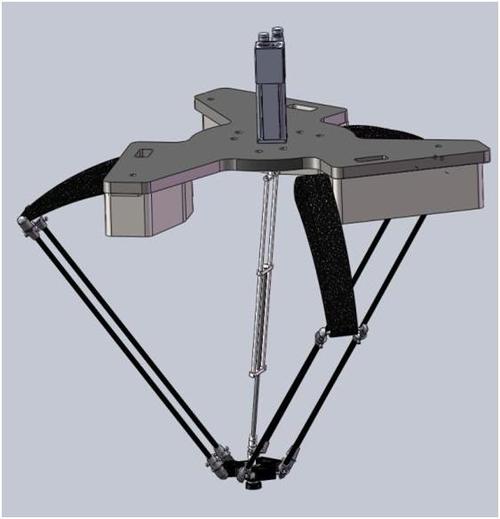
How Does It Work? (Kinematics and Motion)
The core principle of a Delta robot is parallel kinematics. This is in contrast to the serial kinematics of a traditional 6-axis industrial robot arm (like a KUKA or FANUC robot).
Key Difference: Serial vs. Parallel Kinematics
- Serial Robot (e.g., 6-axis arm): Joints are connected in a "chain" (Base -> Joint 1 -> Link 1 -> ... -> End-Effector). An error in one joint is amplified down the chain, leading to lower accuracy and stiffness. It has a large, often singular, workspace.
- Parallel Robot (Hexa Delta): The end-effector is connected to the base by multiple independent kinematic chains (the 6 legs). Errors are averaged out, leading to very high accuracy and stiffness. The workspace is smaller but more precise.
Motion Principle of the Hexa Delta:
- Base: The stationary base contains six high-precision servo motors (often electric, but can be pneumatic or hydraulic).
- Actuation: Each motor drives a linear actuator (a ball screw or linear motor). This actuator changes the length of one of the six legs.
- Legs: Each leg consists of two parts:
- An upper link connected to the linear actuator.
- A lower link (or "strut") connected to the upper link via a universal joint.
- Moving Platform (End-Effector): The six lower links are all connected to a single, small, triangular or hexagonal moving platform. This platform is also connected to the legs via universal joints.
- Calculating Position: By precisely controlling the length of all six legs simultaneously, the robot's controller can calculate the exact position (X, Y, Z) and orientation (roll, pitch, yaw) of the moving platform. This is a complex calculation involving inverse kinematics.
Key Components
- Base Frame: The rigid, stationary structure that houses the motors and actuators.
- Linear Actuators: Six high-precision devices (e.g., ball screws with rotary encoders) that change the length of the legs. This is the primary "actuation" of the robot.
- Upper and Lower Links: The rigid struts that transmit force from the actuators to the platform. They are connected by universal joints.
- Universal Joints: Spherical joints that allow the links to rotate freely in multiple directions. This is crucial for the parallel mechanism to work without binding.
- Moving Platform (End-Effector): The part of the robot that holds the tool or performs the task. It is much lighter and more rigid than a serial robot's arm.
- Controller: A powerful computer that runs the kinematic calculations, sends commands to the motors, and receives feedback from the encoders to maintain precise positioning.
Advantages
- Extreme Speed: Due to its lightweight moving parts and parallel structure, it can accelerate and decelerate incredibly fast, often exceeding 10 Gs.
- High Precision and Repeatability: The parallel structure provides exceptional rigidity, minimizing deflection and vibration. This allows for very precise and repeatable movements (often in the micrometer range).
- High Stiffness and Rigidity: The six legs share the load, making the structure very stiff. This is ideal for applications requiring high force or precision.
- High Payload-to-Weight Ratio: Because the structure is so efficient, it can move relatively heavy loads compared to its own weight.
- High Dynamic Performance: Excellent for applications requiring rapid, complex movements.
Disadvantages and Challenges
- Complex and Expensive: The design with six high-precision linear actuators, universal joints, and a complex control system makes it significantly more expensive and difficult to manufacture than a 3-axis Delta or a serial robot.
- Limited and Complex Workspace: The workspace is much smaller than a serial robot's arm. It's also not a simple shape and can have "singularities" (positions where the robot loses a degree of freedom or becomes uncontrollable).
- Limited Tool Access: The base structure surrounds the workspace, making it difficult to access the tool from the sides or top, which can be a problem for certain assembly or inspection tasks.
- Calibration Complexity: While inherently accurate, initial calibration is complex due to the large number of joints and links that must be precisely measured.
Applications
The unique capabilities of the Hexa Delta Robot make it ideal for specific, demanding applications:
- High-Speed Pick-and-Place: This is the classic application. It can pick dozens of small items (like chocolates, pastries, or electronic components) per second from a conveyor belt and place them into packaging or trays with perfect accuracy.
- Medical and Laboratory Automation: Handling small, delicate samples in high-throughput screening, automated pipetting, and laboratory analysis.
- Aerospace and Automotive: Precision assembly of small components, drilling, and riveting where high force and absolute precision are critical.
- Simulators and Motion Platforms: Its direct ancestor, the Stewart platform, is the gold standard for flight and driving simulators. The Hexa Delta is a more advanced version of this concept.
- 3D Printing (Additive Manufacturing): High-speed, high-precision deposition of material, such as in multi-material or high-resolution bioprinting.
- Laser Processing and Welding: For tasks requiring extremely fast and accurate movement of the laser head over a small area.
Summary: Hexa Delta vs. 3-Axis Delta
| Feature | 3-Axis Delta Robot | Hexa Delta Robot |
|---|---|---|
| Degrees of Freedom | 3 (X, Y, Z translation) | 6 (X, Y, Z + Roll, Pitch, Yaw) |
| Orientation | Cannot tilt or rotate the tool | Can fully orient the tool in any direction |
| Complexity & Cost | Low | High |
| Workspace | Larger, simpler (a dome) | Smaller, more complex |
| Typical Use Case | High-speed pick-and-place of identical, upright items | Complex assembly, pick-and-place of randomly oriented items, simulation |
In conclusion, the Hexa Delta Robot is a specialized but incredibly powerful tool. It trades the large, versatile workspace of a serial robot for unparalleled speed, precision, and rigidity within a smaller, more defined operational volume. It is the perfect choice for high-speed, high-precision automation tasks where traditional robots fall short.
标签: hexa delta机器人应用场景 hexa delta机器人优势特点 hexa delta机器人选型指南