Of course! Here is a comprehensive English presentation on the applications of artificial intelligence. It's structured with a clear introduction, main body, and conclusion, making it suitable for a speech, a report, or a classroom presentation.
Presentation: The AI Revolution - How Artificial Intelligence is Transforming Our World
(Slide 1: Title Slide)** The AI Revolution: How Artificial Intelligence is Transforming Our World A Look at the Practical Applications of AI Your Name / Date**
(Slide 2: Introduction - What is AI?) [Image: A collage of AI concepts like a brain, robots, data charts, and voice assistants]
Speaker: "Good morning/afternoon, everyone.
Have you ever asked Siri a question, been recommended a movie on Netflix, or used a navigation app to find the fastest route? If so, you've already experienced a small piece of the Artificial Intelligence revolution.
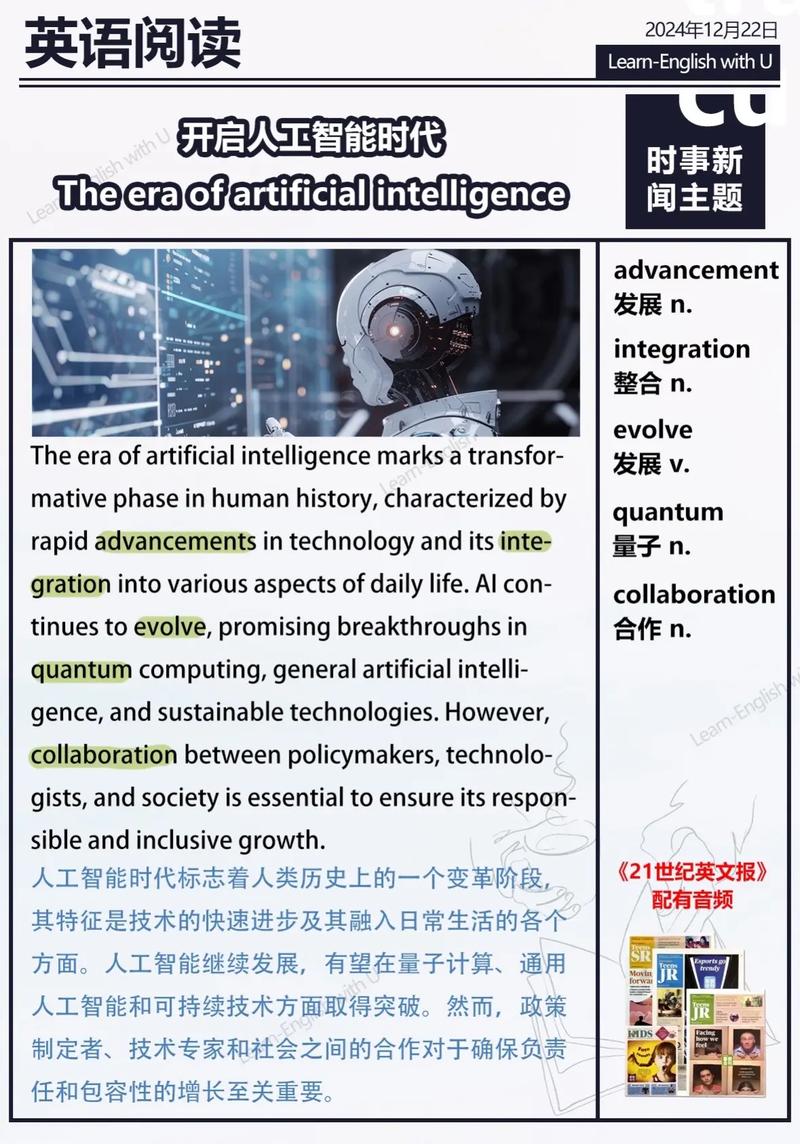
So, what is Artificial Intelligence, or AI? At its core, AI is the science of making machines that can think, learn, reason, and solve problems—tasks that normally require human intelligence. It's not just about robots in science fiction; it's a powerful set of technologies that are already woven into the fabric of our daily lives and are reshaping entire industries.
Today, I want to take you on a journey to explore the diverse and exciting applications of AI across different sectors."
(Slide 3: AI in Our Daily Lives) [Image: A person using a smartphone with various apps like Spotify, Google Maps, and a shopping cart]
Speaker: "Let's start with the most familiar territory: our daily lives. AI is a silent, powerful companion.
- Personal Assistants: Siri, Alexa, and Google Assistant use AI to understand our voice commands, answer questions, control our smart homes, and manage our schedules.
- Entertainment: Streaming services like Netflix and Spotify use AI to analyze your viewing or listening habits. They then recommend movies, shows, and music you might enjoy, creating a highly personalized experience.
- Online Shopping & E-commerce: When you shop on Amazon, AI tracks your browsing history and purchases to suggest products. It also powers the chatbots that answer your questions instantly.
- Navigation: Apps like Google Maps and Waze use AI to analyze real-time traffic data from millions of users. This allows them to calculate the fastest route, predict traffic jams, and even estimate your arrival time with remarkable accuracy."
(Slide 4: AI in Healthcare - Saving Lives) [Image: A doctor looking at a medical scan on a computer screen with AI analysis highlighted]
Speaker: "Perhaps one of the most life-changing applications of AI is in healthcare. AI is helping doctors and save lives in incredible ways.
- Medical Imaging: AI algorithms can analyze X-rays, CT scans, and MRIs with superhuman speed and accuracy. They can detect early signs of diseases like cancer or tumors that might be missed by the human eye.
- Drug Discovery: Developing new medicines is a long and expensive process. AI can dramatically speed this up by analyzing vast amounts of biological data to predict how different drugs will interact, helping to design new, more effective treatments.
- Personalized Medicine: AI can analyze a patient's genetic makeup, lifestyle, and medical history to create personalized treatment plans, moving away from a 'one-size-fits-all' approach.
- Virtual Health Assistants: AI-powered chatbots can provide initial diagnoses, remind patients to take their medication, and offer 24/7 support, making healthcare more accessible."
(Slide 5: AI in Business & Finance - Driving Efficiency) [Image: A stock market graph and a customer service robot interacting with a person]
Speaker: "In the competitive world of business and finance, AI is a game-changer for efficiency and decision-making.
- Customer Service: Many companies now use AI-powered chatbots and virtual agents to handle customer inquiries 24/7. This reduces wait times and frees up human employees to handle more complex issues.
- Fraud Detection: Banks and financial institutions use AI to monitor millions of transactions in real-time. AI can quickly spot unusual patterns that might indicate fraudulent activity and alert the system, protecting customers' money.
- Algorithmic Trading: In the stock market, AI algorithms can analyze market data, news, and social media trends at lightning speed to execute trades, often making decisions faster than any human trader.
- Supply Chain Management: AI helps companies optimize their supply chains by predicting demand, managing inventory levels, and finding the most efficient routes for shipping, saving time and money."
(Slide 6: AI in Transportation - The Future of Mobility) [Image: A self-driving car or an electric scooter sharing app map]
Speaker: "The way we move from place to place is also being transformed by AI.
- Autonomous Vehicles: This is the most famous example. Self-driving cars use a combination of sensors, cameras, and AI to perceive their environment, make decisions, and navigate safely. The goal is to reduce accidents and make transportation more accessible.
- Ride-Sharing & Logistics: Companies like Uber and use AI to match drivers with riders, predict demand to ensure availability, and optimize routes for faster, cheaper trips. Delivery companies like Amazon use AI to manage their complex logistics networks.
- Traffic Management: Smart cities are using AI to control traffic lights dynamically, reducing congestion and improving traffic flow based on real-time conditions."
(Slide 7: AI in Creative Fields & Entertainment) [Image: An AI-generated artwork or a music production software interface]
Speaker: "Many people think AI is only about logic and data, but it's also becoming a powerful creative partner.
- Content Creation: AI can now write articles, create marketing copy, and even compose music. Tools like DALL-E and Midjourney can generate stunning, original images from simple text descriptions.
- Gaming: In the gaming industry, AI is used to create non-player characters (NPCs) with more realistic behaviors and to design complex, adaptive game worlds that change based on the player's actions.
- Film and Animation: AI assists in creating special effects, editing videos, and even animating characters, making the production process faster and more efficient."
(Slide 8: Challenges and Ethical Considerations) [Image: A scale balancing a gear (AI) and a human hand]
Speaker: "Of course, with great power comes great responsibility. The rise of AI also presents significant challenges that we must address.
- Job Displacement: As AI automates tasks, there are concerns about job losses in certain sectors. The key will be to reskill and upworkforces for new roles that work alongside AI.
- Bias and Fairness: AI systems learn from data. If that data contains human biases, the AI will learn and even amplify those biases, leading to unfair outcomes in areas like hiring and loan applications.
- Privacy and Security: AI systems often require vast amounts of data, raising serious concerns about how our personal information is collected, used, and protected.
- Ethical Dilemmas: Self-driving cars, for example, face ethical dilemmas in unavoidable accident scenarios. Who is responsible when an AI makes a decision with consequences?"
(Slide 9: Conclusion - Embracing the Future) [Image: A diverse group of people looking towards a bright, tech-filled horizon]
Speaker: "To summarize, Artificial Intelligence is no longer a futuristic concept. It is a present-day reality that is enhancing our lives, driving innovation in healthcare and business, and redefining transportation and creativity.
The applications we've discussed today are just the beginning. AI is a tool, and like any tool, its impact depends on how we choose to use it. The future isn't about humans versus AI; it's about humans with AI.
Our challenge is to harness this incredible technology responsibly, ensuring it benefits everyone and helps us build a smarter, more efficient, and more equitable future. Thank you."
(Slide 10: Q&A)** Thank You & Questions? Contact Information (Optional)
Key Vocabulary for Your Presentation:
- Artificial Intelligence (AI): The simulation of human intelligence in machines.
- Machine Learning (ML): A subset of AI where computers learn from data without being explicitly programmed.
- Deep Learning: A more complex type of ML using neural networks.
- Algorithm: A set of rules or instructions given to a computer to solve a problem.
- Data Analytics: The process of examining data to draw conclusions.
- Automation: The use of technology to perform tasks with minimal human intervention.
- Personalization: Tailoring a service or product to the individual needs of a user.
- Innovation: The introduction of new ideas, methods, or things.
- Ethics: Moral principles that govern a person's behavior or the conducting of an activity.
- Bias: Prejudice in favor of or against one thing, person, or group compared with another, usually in an unfair way.
标签: 人工智能英语教学应用 人工智能在英语口语练习中的应用 人工智能英语写作辅助工具