核心名称
MIT猎豹机器人最广为人知的官方名称是 MIT Cheetah。
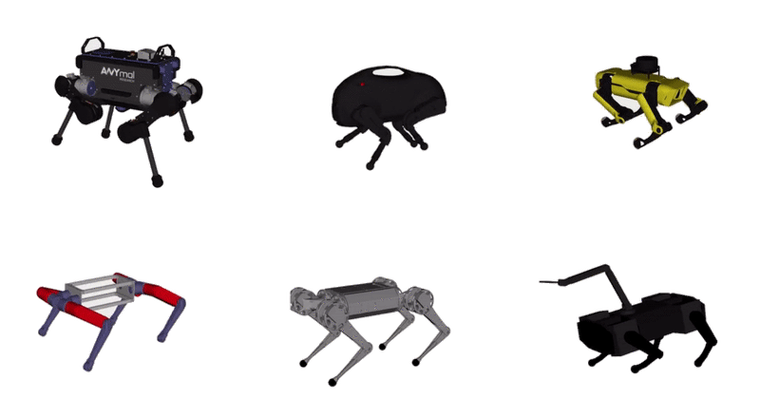
它是一个项目系列,由麻省理工学院 的计算机科学与人工智能实验室 和其仿生机器人实验室 领导,根据具体型号,有时也会用更精确的名称,
- Cheetah 3: 这是最新也是最知名的型号。
- Mini Cheetah: 由麻省理工学院衍生出来的初创公司 ANYbotics 开发的一个更小、更商业化的版本。
英文详细介绍
您可以根据需要选择不同详细程度的介绍。
简短版
The MIT Cheetah is a highly dynamic and agile robot developed by MIT. It is designed to run, jump, and navigate rough terrain with remarkable speed and efficiency, mimicking the movements of a real cheetah. Its advanced control systems and specialized actuators allow it to maintain balance and perform complex maneuvers, making it a leading example of bio-inspired robotics.
标准版
The MIT Cheetah is a pioneering project in the field of legged robotics, spearheaded by MIT's Computer Science and Artificial Intelligence Laboratory (CSAIL). The primary goal of the project is to create a robot that can move with the speed, agility, and efficiency of a cheetah.
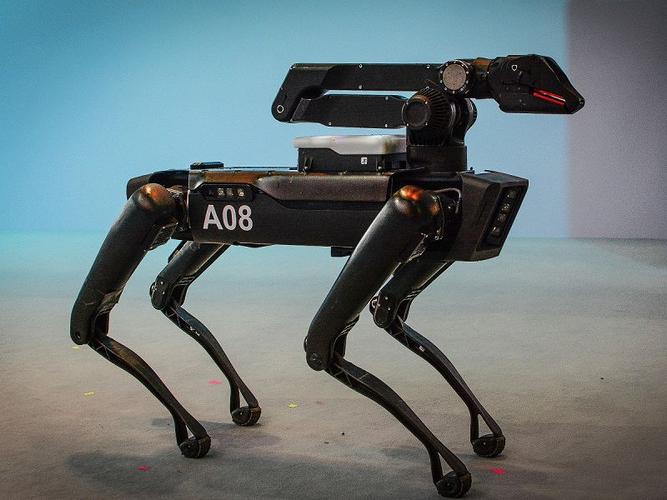
Key features and technologies include:
- Dynamic Movement: It can run at speeds over 28 mph (45 km/h) and can jump over obstacles mid-stride.
- Specialized Actuators: Instead of traditional motors, it uses custom-built, high-torque electric motors with a spring-like mechanism in the leg. This design, known as a "compliant actuator," stores and releases energy with each step, significantly improving efficiency.
- Advanced Control Algorithms: The robot uses sophisticated algorithms to calculate its center of mass and adjust its leg movements in real-time, allowing it to maintain balance and stability on uneven or unpredictable terrain.
- Perception and Navigation: Equipped with cameras and sensors, the Cheetah can perceive its environment and plan its path autonomously.
The MIT Cheetah project has significant implications for search and rescue, disaster response, and exploration in environments too dangerous for humans.
详细版 (可用于报告、演示等)
Project Title: The MIT Cheetah: A Bio-inspired Dynamic Quadruped Robot
Institution: Massachusetts Institute of Technology (MIT), Computer Science and Artificial Intelligence Laboratory (CSAIL)
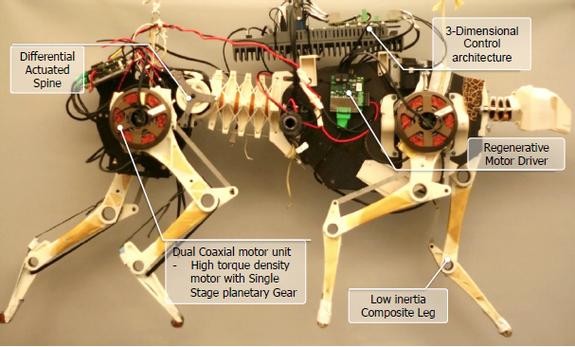
Overview: The MIT Cheetah project represents a landmark achievement in bio-inspired robotics. It is a series of quadruped (four-legged) robots engineered to replicate the unparalleled speed, agility, and energy efficiency of the fastest land animal on Earth, the cheetah. The project's research focuses not just on creating a fast machine, but on understanding and implementing the fundamental principles of dynamic locomotion found in biology.
Key Technological Innovations:
-
Compliant Actuation System: The core of the Cheetah's dynamic performance lies in its legs. Each leg is driven by a custom, high-torque, brushless DC motor paired with a parallel mechanism that includes a spring. This "Series Elastic Actuator" (SEA) acts like a biological tendon. During the stance phase of a run, the leg compresses the spring, storing kinetic energy from the robot's forward motion. This stored energy is then released during the next stride, propelling the robot forward with minimal energy input from the motors. This is why the Cheetah can achieve such high efficiency, far surpassing traditional robots.
-
Model-based Control and Whole-Body Balance: The Cheetah's "brain" is its complex control system. It uses a full-body dynamic model to predict its motion in real-time. By constantly calculating its center of mass, angular momentum, and ground reaction forces, the robot can make micro-adjustments to its leg angles and forces. This allows it to:
- Gallop at high speeds without losing balance.
- Jump over obstacles up to 40 cm (16 inches) high while in full stride.
- Stabilize itself after being pushed or encountering unexpected terrain.
-
Perception and Autonomous Navigation: Equipped with a suite of sensors, including an inertial measurement unit (IMU), joint encoders, and cameras, the Cheetah perceives its environment. The system fuses this sensory data to build a map of its surroundings and plan an optimal path. It can autonomously run across grass, concrete, and even treadmills, adapting its gait to the surface conditions.
Significance and Future Applications: The success of the MIT Cheetah demonstrates the potential of legged robots for traversing complex and unstructured environments that are challenging for wheeled or tracked vehicles. Potential applications include:
- Search and Rescue: Navigating through unstable rubble after an earthquake.
- Military and Defense: Serving as a scout or carrying supplies in the field.
- Industrial Inspection: Inspecting complex infrastructure like pipelines, power plants, and construction sites.
- Exploration: Performing scientific tasks on other planets or in difficult-to-reach terrestrial locations.
核心术语中英对照
| 中文 | 英文 |
|---|---|
| 猎豹机器人 | Cheetah Robot |
| 仿生机器人 | Bio-inspired Robotics |
| 四足机器人 | Quadruped Robot |
| 动态运动 | Dynamic Locomotion / Dynamic Movement |
| 专用执行器 | Specialized Actuators / Compliant Actuators |
| 并联弹簧机制 | Parallel Spring Mechanism |
| 肌腱式驱动 | Series Elastic Actuator (SEA) |
| 能量效率 | Energy Efficiency |
| 模型控制算法 | Model-based Control Algorithms |
| 全身平衡 | Whole-body Balance |
| 重心 | Center of Mass (CoM) |
| 惯性测量单元 | Inertial Measurement Unit (IMU) |
| 自主导航 | Autonomous Navigation |
| 不平坦地形 | Uneven / Unstructured Terrain |
标签: MIT猎豹机器人官方名称 MIT猎豹机器人英文名怎么读 MIT猎豹机器人MIT Cheetah Robot介绍